SOVEREIGN RESEARCH · DEEP DIVE
Advanced Packaging and HBM: The Matched-Supply Constraint
By Pavel Sovereign ·
Historical author publication. Original date and analysis preserved; this is not a new Research OS judgment.
Examines compatible, qualified accelerator sets and the durability of supplier returns as capacity expands.
AI Infrastructure Deep Dive | Pavel Sovereign | Sovereign Research
AI Infrastructure Intelligence for Investors. Researching the capital cycle behind AI — from chips to power. Research cutoff: 11 September 2026. Prices: 10 September U.S. close.
1. Thesis
The marginal accelerator is constrained by the least available compatible combination of logic, HBM and packaging—not by aggregate semiconductor capacity—and the investment opportunity depends on whether the supplier retains the resulting scarcity value after supply catches up.
That distinction changes both the operating model and the valuation question. A memory expansion can increase industry output while leaving a particular accelerator program constrained. A packaging expansion can shorten queues while reducing the premium earned on each completed unit. Customers can benefit from better availability at the same time that suppliers face weaker incremental returns.
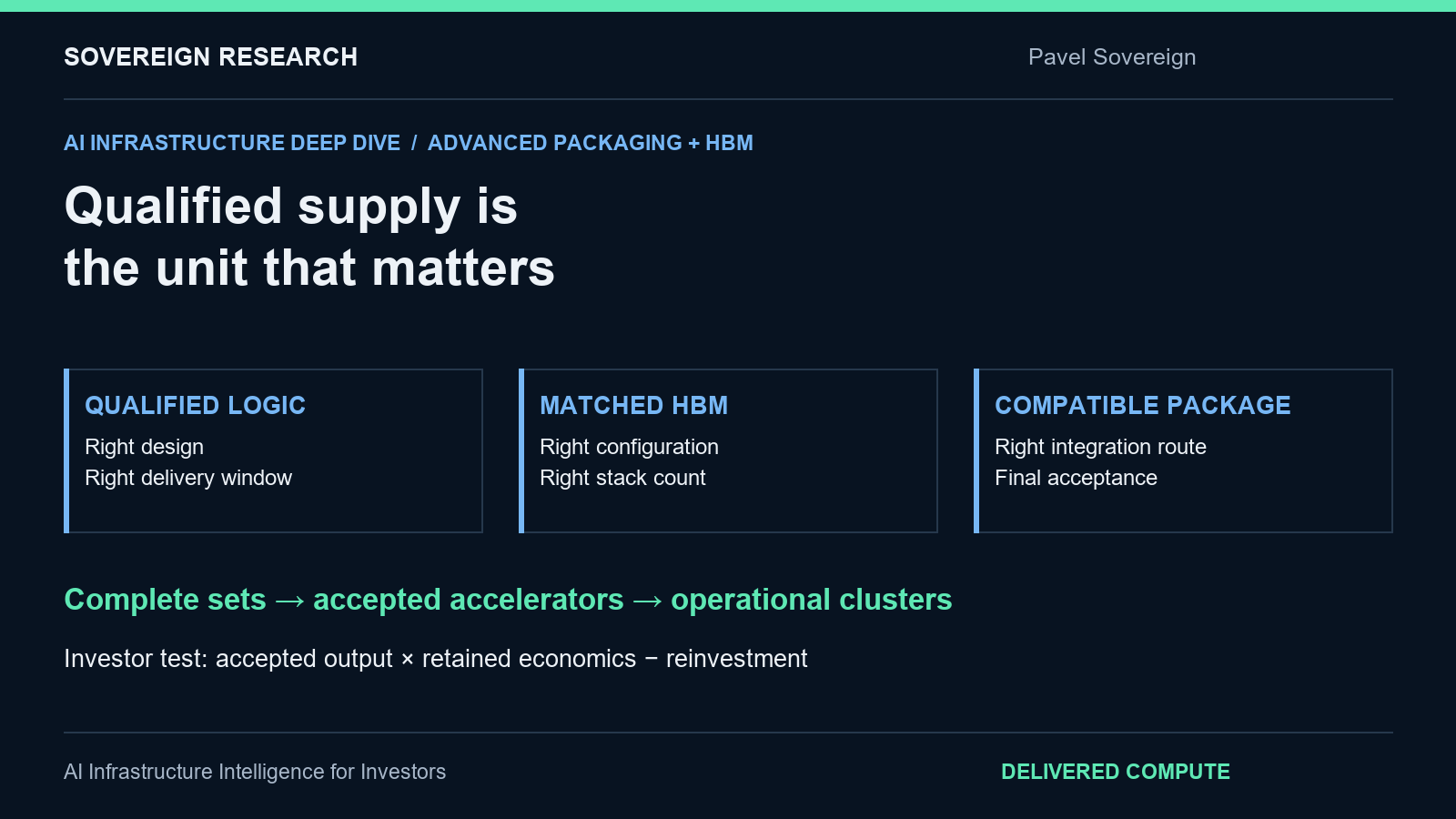
The research object is a qualified accelerator set: functioning logic, the required memory configuration and a compatible package that passes acceptance. It is an intermediate input into Delivered Compute. It becomes monetizable capacity only after server integration, installation, power, networking and workload acceptance.
The working hypothesis is that matching and qualification will remain economically important even as headline capacity grows. The potential expectation gap lies in confusing three different outcomes: more nominal capacity, more accepted accelerators and more durable supplier earnings. They require separate evidence.
2. Why This Matters Now
Verified facts: Micron reported fiscal Q3 revenue of $41.46 billion, non-GAAP diluted EPS of $25.11 and non-GAAP gross margin of 84.9%. Its next-quarter guidance included revenue of $50 billion, plus or minus $1 billion, and non-GAAP EPS of $31, plus or minus $1. These are consolidated company figures, not a standalone HBM income statement. Micron fiscal Q3 results
These disclosures create a difficult investor problem. A company can report exceptional current profitability and appear inexpensive against an annualized quarter. That arithmetic does not establish the earnings level a shareholder will receive across a full investment cycle.
At the product level, Micron announced high-volume HBM4 production for NVIDIA Vera Rubin in March. Its disclosed 36GB, 12-high product offers bandwidth above 2.8TB/s; a 48GB, 16-high configuration was sampling. Production, sampling and customer qualification are different milestones. Micron HBM4 announcement
The variable change is a transition in the type of memory supplied, not merely an increase in bits. Investors need to identify which configurations have moved into accepted volume and which remain contingent. A roadmap cannot be placed in the current supply denominator.
3. System Role
Logic performs the computation. HBM supplies nearby memory capacity and bandwidth. Advanced packaging connects these components within physical, electrical and thermal limits. The package is part of the system design rather than a generic final wrapping step.
TSMC describes CoWoS as a family of integration technologies, including S, L and R implementations. Its documentation shows different interposer approaches and integration scales. These variants should not be treated as an undifferentiated pool of interchangeable capacity. TSMC CoWoS technology
An investor model should therefore start with a specific accelerator generation, memory configuration and packaging route. Count the quantities that can actually be assembled together within the relevant delivery period. Convert memory stacks into accelerator-equivalent sets using that design’s stack requirement. Do not compare raw stack counts with completed package counts.
The next step is acceptance. A component can work independently yet fail the completed system’s requirements. Testing, repair where feasible, final qualification and the customer’s acceptance criteria determine when physical output becomes a saleable unit.
This framework is an analytical model, not a disclosed industry production statistic. Public sources do not provide enough program-level information to calculate a reliable universal matched-supply ratio. The absence of that denominator is itself a reason to resist precise claims about the date scarcity ends.
4. Demand Drivers
Demand for HBM has at least three dimensions: accelerator units, memory per accelerator and product mix. These can move independently. Unit growth can slow while memory content rises. Conversely, a less memory-intensive architecture can increase accelerator shipments without producing the same growth in HBM demand.
Capacity and bandwidth solve different problems. Capacity influences whether the working set fits and how much partitioning or movement is required. Bandwidth influences how quickly data can reach the computing elements. A product with higher bandwidth does not automatically hold a larger model; Micron’s 36GB HBM4 disclosure illustrates why the two variables must be recorded separately.
Workload mix matters as much as device specifications. Training, inference and different inference service requirements generate different memory footprints and access patterns. Software changes can reduce memory traffic or increase reuse. Longer contexts and larger working sets can move requirements in the opposite direction. These are causal possibilities, not a quantified industry forecast here.
The market question is which demand survives a change in architecture or purchasing economics. A customer reservation signals intent. A qualification commitment signals design integration. Accepted shipments and subsequent reorders provide progressively stronger evidence of realized demand. Adding all of these together would double-count the same prospective accelerator.
5. Supply / Bottlenecks
The useful supply question is: how many complete, compatible sets can ship on time? An illustrative batch makes the distinction concrete. Suppose a program has 100 qualified logic units, HBM sets sufficient for 80 accelerators, and 90 compatible packaging slots. Its pre-final-test ceiling is 80 sets.
Increasing packaging slots from 90 to 110 produces no additional complete sets while HBM remains at 80. Increasing HBM sets to 100 then raises the ceiling to 100, assuming logic remains available. If only 90% of that batch passes final acceptance, accepted output is 90. These numbers are deliberately hypothetical; they are not estimates of any supplier’s yield.
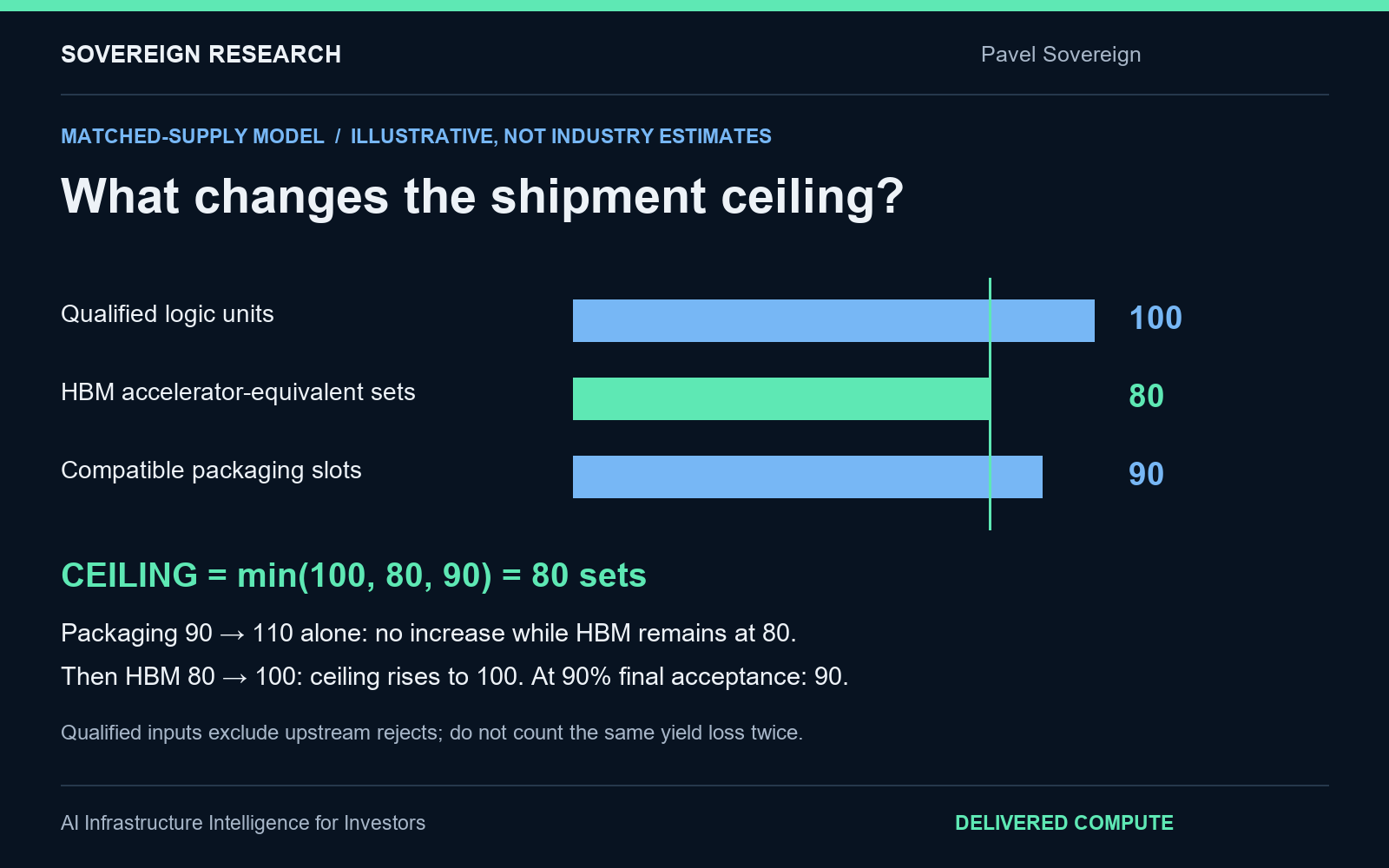
This is a planning ceiling, not a complete factory simulation. Real flows involve work in progress, qualification timing, rework and more than one bottleneck. The acceptance adjustment must not repeat losses already embedded in the qualified input counts. A model that applies the same yield loss twice creates artificial scarcity.
Timing also makes apparently sufficient supply unusable. Memory arriving after the package window can miss the customer’s deployment date. A larger package may require a different production route. A replacement memory supplier may need design validation even if nominal specifications look comparable.
The distinction between structural complexity and shortage is essential. More complicated integration can raise technical barriers without maintaining economic scarcity forever. Competitors can improve yield, add capacity or qualify alternatives. Public technical documentation supports the complexity claim; it does not establish today’s queue length or a guaranteed scarcity premium.
6. Financial Transmission
For a supplier, revenue depends on accepted units, content per unit and realized pricing. Profit then depends on yield, utilization, depreciation, mix and the cost of achieving that accepted output. A larger factory is valuable only if its incremental output earns enough after those costs.
For the customer, the relevant benefit is the value of avoiding a deployment delay. That value can be high when a complete cluster is waiting on one missing input. But customer urgency does not reveal which supplier captures the benefit. Contract terms, substitute designs, qualification costs and bargaining power determine the split.
Cash flow can diverge from reported profitability. Capacity additions absorb cash before generating accepted output. Inventory can rise because demand is growing or because components are mismatched. The same inventory increase therefore has different meanings depending on its composition and age.
Micron says its strategic customer agreements should improve predictability. That is management’s expectation; publicly available headline descriptions do not establish every price floor, cancellation right or allocation obligation. Treat contractual durability as a question to investigate rather than as a fully verified floor under earnings.
The important transmission chain is demand commitment to qualified output, then accepted sales, then cash retained after expansion. Revenue growth alone stops the analysis too early. A supplier with less headline growth but better yield and lower reinvestment requirements can generate more owner value from each incremental dollar of sales.
7. Market Expectations
There is no verified, date-stamped analyst consensus series in this note. Company guidance is identified as guidance; the valuation sensitivities below are our calculations. Neither is relabeled as what all investors believe.
The visible debate is still testable. A durable-earnings interpretation requires advanced memory to retain favorable economics as capacity expands. A normalization interpretation allows strong unit demand while pricing, mix or margins retreat. Both interpretations can be consistent with growing AI infrastructure spending.
The discriminating evidence is the direction of earnings relative to accepted volume. If shipments grow and margins hold while cash conversion remains healthy, durability gains support. If shipments grow but pricing and incremental cash returns weaken, the normalization case gains support. That second outcome would not prove AI demand disappeared.
Investor surprise also depends on the starting point. Beating a product launch timetable may matter little if the valuation already assumes smooth execution. A smaller revenue increase with better cash returns might matter more than a larger increase funded by disproportionate capital spending.
8. What Is Already Priced In
Micron closed at $977.41 on 10 September. Annualizing the reported non-GAAP quarterly EPS gives $100.44; annualizing the next-quarter guidance midpoint gives $124. The corresponding price ratios are approximately 9.73 times and 7.88 times. These are mechanical run-rate ratios, not trailing or consensus forward P/E multiples. Dated MU price history
The distinction matters because a quarter can contain unusually favorable economics. Multiplying it by four assumes those economics persist. It does not estimate seasonality, future dilution, changing prices or the cost of sustaining production. Non-GAAP earnings also require comparison with GAAP results and cash generation.
Reverse the exercise. At illustrative earnings multiples of 10, 15 and 20 times, the same share price corresponds to sustainable annual EPS of $97.74, $65.16 and $48.87 respectively. These multiples are assumptions, not fair-value judgments. Their purpose is to expose how much normalization different valuation conventions can tolerate.
The price therefore cannot be described simply as assuming either permanent scarcity or an imminent collapse. It is compatible with several combinations of earnings duration and required return. What is already visible is that strong current earnings are available to every investor; their existence is not an undiscovered catalyst.
An upside case needs a defensible reason for earnings to remain higher for longer than the investor’s own normalization assumption. A downside case needs a mechanism that lowers sustainable earnings or the multiple paid for them. A low run-rate ratio alone supplies neither.
9. Potential Expectation Gap
The potential gap is between aggregate capacity growth and product-specific readiness. Investors may see an expansion announcement and assume the bottleneck has disappeared. Customers may still need a particular stack, interface, package and qualification window. In that situation, selected supply can retain value even as broad availability improves.
The opposite gap is equally plausible. Investors may extrapolate today’s complexity into permanent pricing power. If yields improve and compatible supply catches up, the same technical ecosystem can deliver more accelerators while distributing more of the benefit to buyers.
Our working hypothesis favors persistent matching complexity, not permanent shortage. To turn that hypothesis into an attractive security, the investor must identify a supplier whose accepted output, contractual economics and reinvestment burden produce durable per-share cash growth at the entry price. This note does not establish that security-level conclusion.
10. Bull / Base / Bear
Bull: qualification broadens without destroying economics. Accepted units and content rise, incremental yields improve, and customers maintain commitments across product transitions. Cash generation supports expansion without a disproportionate increase in balance-sheet risk. The positive surprise is duration of profitable output, not another large capacity announcement.
Base: supply expands unevenly. Some configurations remain constrained while others become more available. Unit growth offsets part of the normalization in pricing and mix. The infrastructure system benefits, but shareholder returns depend on the starting valuation and the supplier’s capital discipline.
Bear: customer schedules slip or alternatives qualify faster than expected after suppliers commit expansion capital. Inventory ages, pricing softens and depreciation arrives ahead of adequate utilization. The negative surprise is weaker cash returns despite continued industry volume growth.
These are conditional scenarios, not assigned statistical probabilities. No public matched-supply time series supports a calibrated distribution. The purpose is to make the next observation capable of changing the judgment.
11. Invalidation
The matching thesis would weaken materially if multiple relevant accelerator programs obtained interchangeable, qualified memory and packaging capacity with short lead times and little delivery dispersion. Persistent improvement across several programs would matter more than an isolated successful ramp.
The earnings-durability hypothesis would fail separately if accepted volume increased while sustainable pricing, margins and cash returns deteriorated beyond the investor’s normalization case. A technical moat can remain intact while its investment payoff disappoints.
Demand also needs an independent failure test: repeated order reductions, slower deployment acceptance or insufficient customer economics could reduce the value of completing the set. A supplier’s strong quarterly shipment does not invalidate downstream weakness that becomes visible later.
12. Variables to Watch
Qualified output: product-specific volume milestones and customer acceptance, separating samples from revenue shipments.
Matched inputs: HBM capacity and bandwidth configuration, stacks per accelerator, compatible packaging route and delivery alignment.
Yield and working capital: accepted units per input, rework disclosures, inventory composition and aging. Unknown values remain unknown.
Economic capture: realized mix and pricing, margins, contract terms, capital spending and cash retained after investment.
Valuation: sustainable per-share earnings under explicit normalization assumptions, rather than annualized peak-quarter earnings alone.
Downstream conversion: server acceptance, power availability and workload readiness, without counting upstream shipments as Delivered Compute.
No single indicator is sufficient. The strongest evidence would combine more accepted output, stable customer economics and cash returns that survive the next capacity ramp.
13. Bottom Line
Advanced packaging and HBM convert separately impressive components into an accelerator that can actually enter service. The investment unit is the compatible, accepted set; the return unit is cash retained after creating it.
Follow qualification and matching to understand supply. Follow normalization and reinvestment to understand the stock. The two questions meet at profitable accepted output, not at a headline capacity number.
Key sources: Micron fiscal Q3 2026 results; Micron March 2026 HBM4 announcement; TSMC CoWoS technology documentation; Stock Analysis dated MU price history. Links appear at the relevant claims. Numerical sensitivities and illustrative supply calculations are Sovereign Research analysis.
Full Research
https://pavelsovereign.com/research/publications/advanced-packaging-and-hbm-the-matched/
Relevant Variables
Historical publication; original variable framework is preserved in the article.